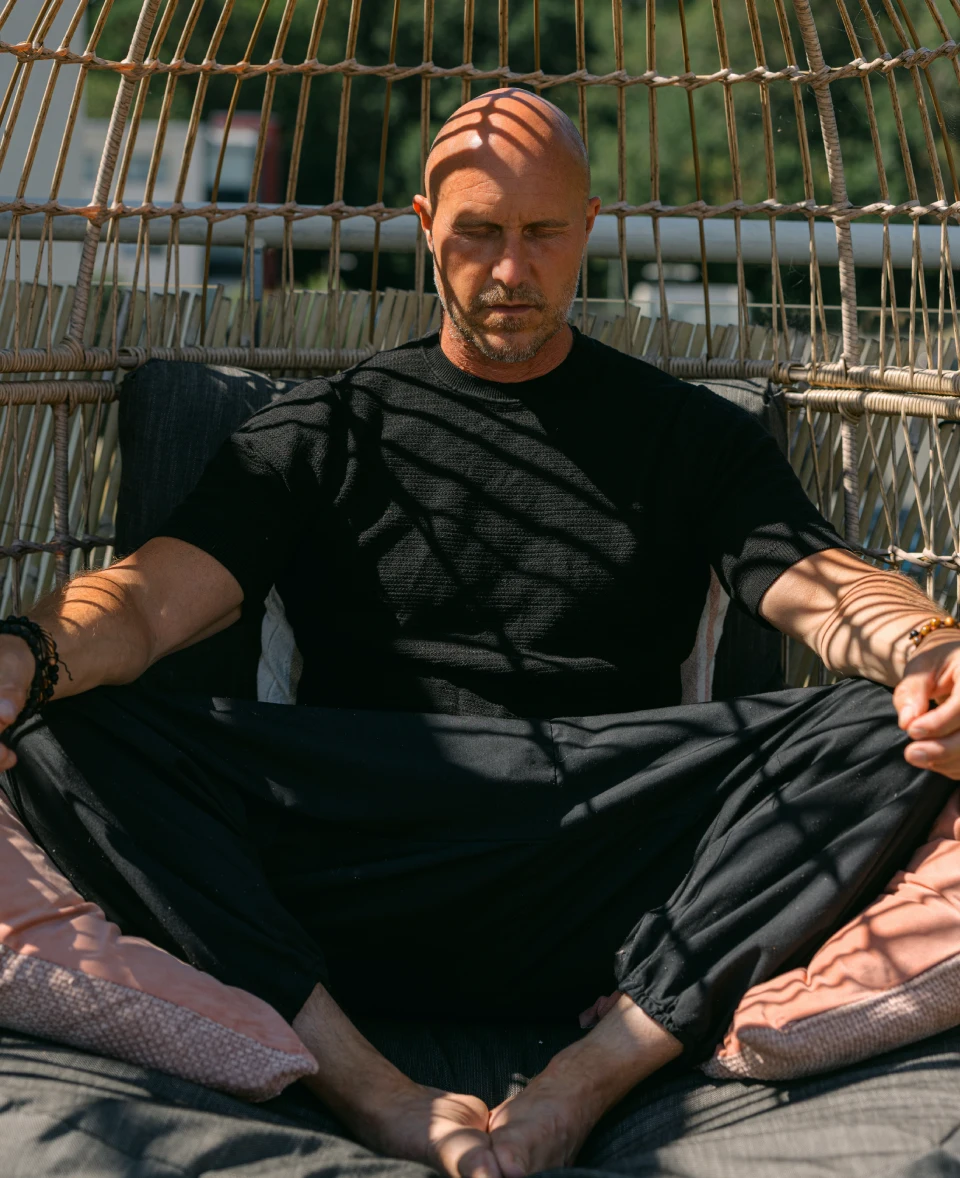
Meditation goes through three stages.
At the start, it feels impossible. You sit down, close your eyes, and your brain immediately produces a shopping list, an argument you lost in 2011, and a burning need to check your phone.
Then, one day, you arrive at your first genuine moment of silence — and you’re hooked.
And eventually it becomes something you can pull out whenever you need it. A superpower, sitting quietly in your back pocket.
“I tried it, couldn’t get it, gave up”
I recommend meditation to a lot of my clients. That sentence is the response I get most often.
And I get it. For years I went in and out for exactly the same reason. I couldn’t get any peace and quiet out of my own monkey mind, and I concluded that meditation simply wasn’t for me. Some people can sit still with their thoughts. I wasn’t one of them.
Then one year I decided to just stick with it. No expectations, no judging each session, no deciding after four days that it wasn’t working.
Eight weeks in, I got a moment. A genuine, momentary state of peace. Mind quiet. Nothing happening.
That was it. I was in.
The progression
It didn’t stay the same after that. It evolved.
I started with guided meditations — someone else’s voice doing the heavy lifting, giving my mind a job so it couldn’t wander off.
Then I moved to Hz music — no instructions, just tone. Less scaffolding, more space.
Eventually, nothing but silence. No app, no voice, no track. Just me and the quiet.
You don’t skip to the end. Each stage taught me something the next one needed.
Why this matters now
We are surrounded by noise 24/7. Notifications, feeds, headlines, podcasts in the gym, something playing in the background of every room. Most men over 40 I work with haven’t sat in genuine silence in years — possibly decades.
My hope is that everyone gets to experience that quiet at least once in their life. It’s a different relationship with your own head, and once you’ve felt it, you know it’s available to you.
It’s persistence, not talent
Like most things worth doing, getting into meditation is nothing more than persistence and consistency.
You are not uniquely bad at this. Your mind is not busier than everyone else’s. You just stopped before it started working.
Stop telling yourself it’s not for you, or that you’ll never get it.
You will.
My 5 tips for mastering meditation
1. Stop trying to empty your mind. That’s not the job. The job is noticing you’ve drifted and coming back. Every time you notice and return, that’s a rep. The wandering isn’t failure — it’s the exercise.
2. Go smaller than feels worthwhile. Five minutes daily beats thirty minutes twice a month. Consistency builds the skill; heroic sessions build resentment.
3. Anchor it to something you already do. First thing after you wake, or last thing before bed. A meditation habit floating loose in your day will never land.
4. Use scaffolding at the start, and don’t feel guilty about it. Guided sessions and Hz tracks aren’t cheating. They’re training wheels, and everyone needs them.
5. Give it eight weeks before you judge it. You wouldn’t judge a training block after four sessions. Same rules apply here.
2 things you can do today
Sit for five minutes with no input. No phone, no music, no podcast. Set a timer, close your eyes, breathe. That’s the whole task. It will feel long and slightly ridiculous. Do it anyway.
Put tomorrow’s session in your calendar. Same time, five minutes. Treat it exactly like a training session — because that’s what it is.
What it gives me now, years in
Instant sleep. Quieting the mind is the single most reliable thing I’ve found for falling asleep. No wind-down routine competes with it.
Being present. Clearing space to meditate strips out the noise of the day. Whatever’s been rattling around since morning gets put down.
Connection with your inner self. This comes out of the first two. Once the noise drops and you’re actually present, there’s something underneath it worth listening to.
A sense of peace. Not a mood — a baseline. It sits under the day rather than depending on how the day goes.
A sense of oneness. Harder to describe, and I won’t try too hard. You’ll know it when you get there.
Hopefully this helps you on your way.
Let me know how you get on.
James